Friday, October 10, 2014

Brain On Fire

Balance issues, anxiety, paranoia, motor coordination issues, numbness in the arms and legs, mood swings, speech issues, sensitivity to light and sound, and eventually becoming withdrawn and detached, all in a short period of time. Sound familiar?  Brain on Fire is a book by Susannah Cahalan, a normal 24 year old who suddenly develops these mysterious symptoms and deteriorates rapidly. You might be surprised that she does not have OMS, but rather another rare disease that bears striking resemblance to OMS.   However, the symptoms are so close, that for the first time we may have a vivid glimpse into what Keira may have experienced when first diagnosed.  In fact an older OMS patient we know was in tears through parts of this book because of many of the similarities with OMS.

Another interesting coincidence is that the disease in this book was only officially identified in 2007 by a Dr. Joseph Dalmau, a neurologist who has also been interested in OMS research.


As Keira’s mom I have always wondered how Keira  felt during our time in the hospital. It was heart-breaking to watch my 18 month-old have her body start turning on her.  She lost the ability to feed herself, started tripping and falling and eventually stopped talking.  Even worse while we were in the hospital she used to wake up in inconsolable states of despair.  She would look through you and just cry.  I remember telling my sister that if it wasn’t 2010 they might send us away to see a priest instead of a doctor.

Brain on Fire is the true story of Susannah Cahalan's "lost month of madness," most of which she remembers imperfectly or not at all. However, since she is a reporter for the New York Post, she has been able to piece together much of what happened by speaking to doctors, nurses, friends, and family; reading "thousands of pages of medical records"; consulting her dad's journal and her parents' "hospital notebook"; watching video footage of herself; and trying to reconstruct any impressions that she still retains.

Cahalan's symptoms were a mixture of the physical (weakness on her left side, difficulty speaking) and the mental (paranoia, violence and psychosis). Her condition was undiagnosed for an agonizing period of time, much like most OMS patients.

Some of her physicians thought she was suffering from alcohol withdrawal despite the fact that she told them she was only an occasional drinker. She came very close to being diagnosed as a schizophrenic. Her family insisted that her illness had a physical cause and only with this advocacy was she admitted to NYU.

After a variety of physicians examined her and ran batteries of tests--but failed to pinpoint the exact cause of her physical and mental deterioration--Susannah found her savior in Dr. Souhel Najjar, "the man to go to when nothing made sense." He suspected that she might be suffering from autoimmune encephalitis and an oncologist named Dr. Josep Dalmau confirmed the diagnosis. Soon, Dr. Najjar began a multi-faceted treatment program to reduce the inflammation in Susannah's brain and neutralize the harmful antibodies that were wreaking havoc in her system.

One other really interesting coincidence in this book is that Dr. Josep Dalmau who first categorized the disease that Susannah had, Anti-NMDA receptor encephalitis, has also expressed interest in researching OMS.


Tuesday, September 30, 2014

Could OMS unlock secrets to new cancer treatments?

Could OMS unlock secrets to new cancer treatments?

Many of you will recall Keira’s original Neuroblastoma/OMS diagnosis -- cancer and autoimmune disease.  The Neuroblastoma had for some reason triggered her immune system to respond, which in turn cross-reacted with her nervous system to cause the autoimmunity of OMS.  Why is this interesting?
  • Cancer typically evades the immune system because cancer cells are you own
  • In OMS, cancer does trigger an immune response, but not known why
  • Neuroblastoma in OMS cases tend to have a good prognosis; believed to be due to the immune response against the cancer.  
  • Neuroblastoma is discovered in about 50%-60% of OMS cases. In the cases where they don't find a Neuroblastoma, many researchers now believe that it once existed and the immune response led to the cancer regression -- which is miraculous! 
In this article from the Institute of Cancer Research, Dr. Louis Chesler discusses how understanding the mechanisms at play with OMS could one day lead to developments in cancer immunotherapy, an emerging form of treatment where drugs utilize the bodies immune system to fight cancer.
This is yet another reason why research for OMS is important. It can help Keira and kids afflicted with OMS but also provide insights that could lead to treatments for a broad array of cancers.
If you've already made a donation, THANK YOU for your support. If you haven't please consider doing so (100% of your donations will go directly to fund research).


$3K More Needed

Donate to Naveen
$11K More Needed
Thanks! Crystal, Keira, Akemi and Naveen

Sunday, September 28, 2014

Why is Naveen riding his bike 700 miles?!


700 Miles In A Week!

This fall I’ll be riding my bike 700 miles from Austin to New Orleans with the Pablove Foundation to raise money for pediatric cancer research.  As most of you know this ride is personal as 3+ years ago our 18-month old daughter Keira was diagnosed with an extremely rare cancer (Neuroblastoma) + autoimmune (OMS) diagnosis.  She’s battled through cancer but continues to battle the OMS that came with it.

2/3 Young Cancer Survivors Face Secondary Disorders

In the last 20 years, only two new drugs have been developed childhood cancers and <4% of the National Cancer Institute's budget is directed to childhood cancer research.  That’s for all kids cancers, and doesn’t even touch the myriad of secondary disorders and issues that 2/3 young cancer survivors deal with, OMS being just one of the rarest of these.

OMS, The Disease You Never Heard Of

OMS is a neurological autoimmune disease that affects motor, cognitive, and behavioral development and was triggered by cancer.  What’s miraculous about it though is that at it’s core, the body detected and mounted an immune response to cancer (which typically evades the immune system).  The unfortunate side-effect was that it also triggered an autoimmune disease.  But understanding this mechanism could not only help kids w/ OMS, but also shed light on how a broad array of cancers could be treated in the future.

What We're Doing About It

There is virtually no research on the subject. However, last year, through your support we funded TWO seed grants specifically for OMS, virtually unheard of for a disease this rare.  Which is why I continue to pedal away.  With your help we can sustain and diversify our research, potentially unlock insights behind the immunity and cancer, and help kids within their lifetimes. 

Thanks for reading, considering and if you do decide to support, please see the steps below (100% of donations go directly to research):

Step 1 - Donate http://stayclassy.org/nv 

• Click on the PINK donate button
• Choose to make your donation public or anonymous

If you're interested in learning more about our work, the research grants or the Pablove Foundation, click here for more info.  

Thanks! 

Thursday, September 11, 2014

A note from the pablove foundation... Two is way better than one.


As you know, your generous support allowed The Pablove Foundation and the Viswanatha family to reach a major milestone in 2014. We funded not one, but two groundbreaking research projects that will help us find answers for Opsoclonus Myoclonus Syndrome and its connection to the childhood cancer neuroblastoma.

The Viswanathas are like family to all of us at The Pablove Foundation, and making progress against OMS is a cause that is is very close to our hearts. As an "orphan" disease, OMS receives close to no funding or attention unless people like you and me get involved. The autoimmune disease attacks a child's neurological system, resulting in severe motor, cognitive, and behavioral complications. That's why we are so proud to have you by our side to fund two incredible initiatives to uncover answers!

Our Scientific Advisory Committee chair (and head of oncology at Children's Hospital Los Angeles), Dr. Leo Mascarenhas, is a rockstar at explaining our scientific research grants. Here are two highlights from this summer's announcement that explain the projects we funded with your support:

11:03 - "Dr. Bethen Lang [of Oxford University] is going to use mass spectrometry, which is a technique to isolate [OMS] specific antigens. Antigens are things which cause the body to respond against them in [children with OMS]. So if we find a way of blocking antibodies from finding those [OMS] antigens, those antibodies won't attack the brain and won't attack the eyes and make them do these bizarre things."
11:40 - "Dr. Gregory Owens [of the University of Colorado Denver] is taking this one step further. [OMS] is caused by antibodies, which go and attack the brain and the spinal column and the eyes. And what makes antibodies are b-cells. So he has collaborated with a scientist who has collected spinal fluid from around the brain and is going to assess these antibodies in the fluid and then find ways in which he can stop the b-cells from producing these antibodies."
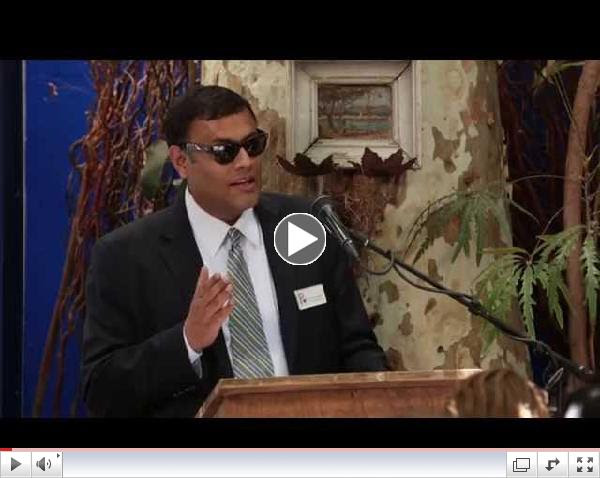
Watch our rockstar deliver the full report on our OMS Grants
Watch Dr. Leo Mascarenhas deliver the full report
on the OMS Grants we funded in 2014
Thank you for helping us mark this milestone with the Viswanatha family. Because of your generous support, we are funding progress and fighting childhood cancer with love.

with gratitude
+
pablove, 

Megan McMillan
Community Affairs Director 
The Pablove Foundation 

p.s. Read up on all six of the Childhood Cancer Research Grants that we awarded this year on the Pablove Blog. 

p.p.s. Crystal and Naveen are riding Pablove Across America again this year! I can't wait to cheer for them at the finish line in New Orleans. Go Team V!